
 English EN
 中国 CN
中国 CN
 French FR
 German DE
 Portuguese PT
 Spanish ES
 Russian RU
 Japanese JA
 Korean KO
 Arabic AR
 Turkish TR
 Italian IT
Performance analysis of new oil cooler plate heat exchanger designs
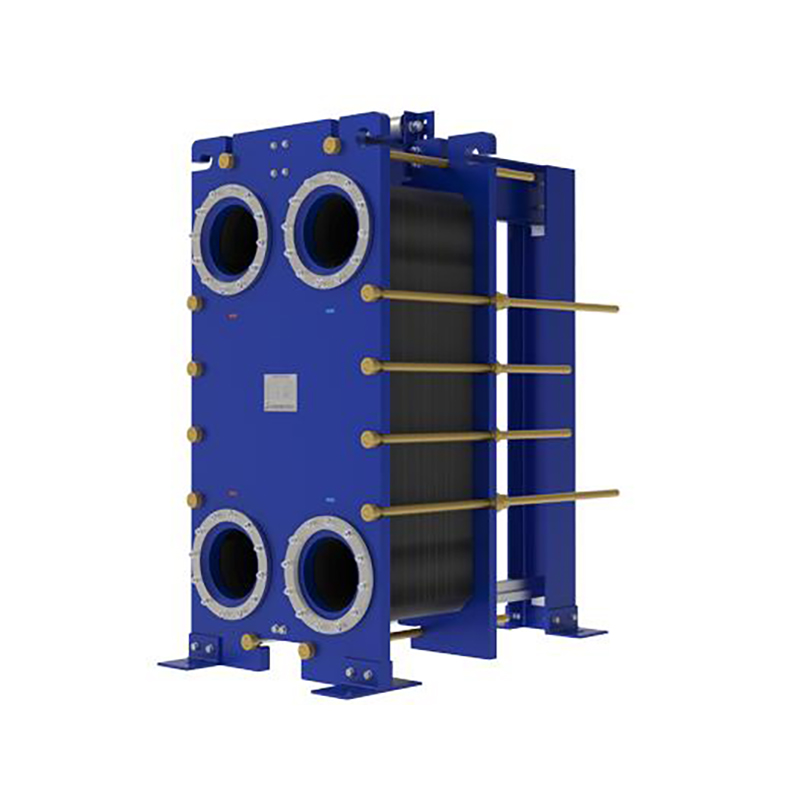
The latest oil cooler plate heat exchanger models deliver improved performance compared to earlier designs. Efficiency, durability, and adaptability are critical in today’s industrial and engine applications. Shanghai Heat Transfer’s Gasketed Plate Heat Exchanger stands out as an innovative solution.
The global market for plate heat exchangers is expanding rapidly, driven by increased adoption in HVAC, construction, and oil cooler applications.
Advanced plate geometry and specialized surface textures maximize heat transfer efficiency.
Material upgrades, such as harder alloys, protect against mechanical wear and chemical attack.
Modular designs with reinforced plate patterns ensure adaptability and reliable thermal operation.
Oil Cooler Plate Heat Exchanger Innovations
Plate Geometry and Turbulator Advances
The evolution of oil cooler plate heat exchanger technology has transformed industrial standards. Modern plate geometry uses advanced corrugated patterns and cylindrical turbulators to increase fluid turbulence. This approach disrupts the boundary layer, which boosts heat transfer and overall efficiency. The following table summarizes key findings on turbulator and plate geometry improvements:
Findings | Description |
|---|---|
Turbulators | Cylindrical turbulators enhance fluid turbulence and improve heat transfer. |
Performance | At low Reynolds numbers, the channel’s performance increases with turbulators. |
Correlations | Relationships exist between Reynolds number, Prandtl number, and geometry. |
Shanghai Heat Transfer’s Gasketed Plate Heat Exchanger stands out for its innovative plate design, which maximizes thermal performance and supports a compact footprint.
Material Upgrades for Durability
Material selection plays a critical role in the durability and reliability of oil cooler plate heat exchangers. Recent advancements include the use of AISI 316 stainless steel, AVESTA 254 SMO, copper, and nickel. These materials offer superior resistance to corrosion and mechanical stress. The table below highlights common materials and their benefits:
Material Type | Description |
|---|---|
AISI 316 | High durability and corrosion resistance |
AVESTA 254 SMO | Excellent resistance to pitting and crevice corrosion |
Copper | Superior thermal conductivity for brazing |
Nickel | Strength and corrosion resistance in brazed units |
Shanghai Heat Transfer’s products use these advanced materials to ensure long service life in demanding environments.
Modular Design and Scalability
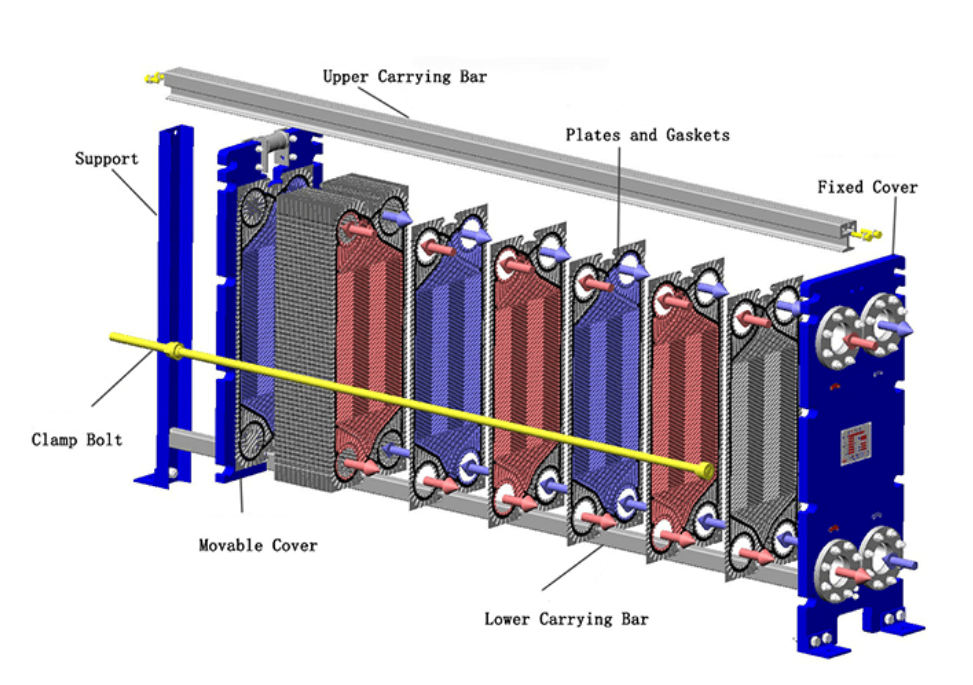
Modular design has become a defining feature of the modern oil cooler plate heat exchanger. This approach allows users to expand or reduce capacity by adding or removing plates. The table below outlines how modularity supports scalability and flexibility:
Aspect | Contribution to Scalability and Flexibility |
|---|---|
Modular Configurations | Easy expansion or reduction of heat transfer capacity |
Standardized Connection Points | Seamless integration and reconfiguration for different operational scales |
Flexible Frame Systems | Adaptation to various plate sizes without full system replacement |
Shanghai Heat Transfer’s Gasketed Plate Heat Exchanger exemplifies this innovation, offering unmatched adaptability for changing process requirements.
Performance Metrics and Efficiency
Heat Transfer Coefficient Improvements
Modern oil cooler plate heat exchanger designs have set new benchmarks for thermal efficiency. Engineers have optimized plate surfaces with advanced corrugated patterns and specialized geometries. These enhancements increase turbulence and maximize surface area contact between fluids. As a result, convective heat transfer coefficients have improved significantly. New models deliver higher thermal efficiency compared to traditional heat exchangers, while maintaining acceptable pressure drops. The Energy Efficiency Index (EEI) has become a crucial metric in recent technical literature. EEI quantifies the overall heat transfer coefficient relative to the equivalent flow pressure drop. A higher EEI means the exchanger achieves greater heat transfer rates for the same pumping power. This metric is vital for evaluating efficiency improvements and operational cost reductions.
Pressure Drop and Flow Distribution
Pressure drop is a key factor in the performance of oil cooler plate heat exchangers. Engineers monitor pressure drop values to ensure optimal system operation. The following table shows typical pressure drop values observed in modern exchangers:
Reynolds Number (Re) | Pressure Drop (Pa) |
|---|---|
1 | 89.08 |
60 | 5900.24 |
Uniform flow distribution is essential for maximizing thermal efficiency. Advanced exchanger designs ensure each plate receives equal fluid flow. This uniformity enhances heat transfer, reduces pressure drops, and prevents fouling. Improved flow distribution lowers maintenance needs by minimizing mechanical degradation and corrosion. These features contribute to reliable performance and longer service life.
Maintenance and Longevity Factors
Maintenance practices play a critical role in extending the longevity of oil cooler plate heat exchangers. The following strategies have proven effective in industrial applications:
Integrated fouling mitigation strategies maintain heat transfer efficiency over time.
Design features for easy disassembly allow quick access during maintenance.
Innovative plate designs and flow channel configurations minimize fouling accumulation.
Gasket and sealing technology improvements prevent leakage and maintain efficiency.
Monitoring and predictive maintenance systems enable real-time assessment and timely interventions.
Proper design and operational controls manage thermal and mechanical stresses.
Effective cleaning methods, including self-cleaning plate designs and anti-fouling surface treatments, restore thermal performance and reduce operational downtime.
Certifications such as ASME, CE, and ISO are important for ensuring performance and reliability. The table below highlights the relevance of these certifications:
Certification | Importance | Relation to Performance and Reliability |
|---|---|---|
ASME | Ensures safety, reliability, and compliance in high-pressure and high-temperature applications | Critical for optimal performance in industrial applications |
CE | N/A | N/A |
ISO | N/A | N/A |
Shanghai Heat Transfer’s Gasketed Plate Heat Exchanger meets these standards, providing users with confidence in durability and operational excellence. These exchangers offer superior corrosion resistance, robust design, and advanced maintenance features. Users benefit from reduced downtime, lower operational costs, and sustained thermal efficiency throughout the product lifecycle.
Application Scenarios: Engine and Marine Use
Engine Cooling Solutions
Oil cooler plate heat exchanger technology plays a vital role in modern engine cooling systems. These exchangers help manage heat generated during operation, supporting optimal performance and reliability. The following table summarizes key application areas for engines:
Application Area | Description |
|---|---|
Jacket Water Cooling | Dissipation of high-grade heat from main engines and gensets. |
Central Cooling Systems | Interfacing fresh water loops (LT/HT circuits) with raw seawater. |
Lube Oil Cooling | Viscosity stabilization for main propulsion and auxiliary machinery. |
Engine cooling solutions benefit from advanced oil cooler plate heat exchanger designs. Optimized systems can increase thermal efficiency by up to 15%, improve fuel economy, and reduce emissions. Effective cooling reduces oil temperatures by up to 40%, which extends engine life and decreases wear by as much as 50%. These improvements support better lubrication and lower friction.
Marine Oil Cooler Challenges
Marine environments present unique challenges for oil cooler plate heat exchangers. Saltwater exposure leads to corrosion, which can degrade materials. Shanghai Heat Transfer uses corrosion-resistant alloys and protective coatings to address this issue. Temperature fluctuations affect performance, so advanced control systems adjust cooling capacity automatically. Vibration and shock are common on vessels. Robust mounting systems and vibration-damping materials help maintain reliability. Fouling and biofouling reduce efficiency, but self-cleaning mechanisms and smooth surfaces prevent buildup. Space constraints require compact designs. Compatibility with existing marine systems is essential, and customized solutions ensure seamless integration. Maintenance in remote locations can be difficult, so comprehensive programs and crew training are provided. Energy-efficient designs help balance operational costs.
Industrial and Food Sector Applications
Oil cooler plate heat exchangers are widely used in industrial and food processing sectors. These exchangers operate efficiently in extreme temperatures and high-pressure environments. Shanghai Heat Transfer’s solutions meet strict regulatory standards, including requirements from the General Administration of Customs and the Ministry of Ecology and Environment. Safety and inspection protocols ensure compliance. In food processing, exchangers support pasteurization and cooling, maintaining product safety and energy efficiency.
Tip: sacoc systems play a crucial role in engine integration and optimization. They manage thermal loads in turbofan engines, simplify oil cooling, and enhance reliability. Strategic placement in bypass ducts allows effective heat dissipation, improving fuel efficiency and supporting sustainability goals.
Experimental Results and sacoc Insights
Laboratory and Field Testing
Recent laboratory and field tests have demonstrated the reliability and efficiency of new oil cooler plate heat exchanger designs. Engineers evaluated these exchangers under demanding conditions, including pressures up to 15 MPa and temperatures reaching 650 °C. The following table summarizes key test results:
Test Parameter | Result |
|---|---|
Operating Conditions | 15 MPa, up to 650 °C |
Tested Medium | High-temperature helium, s-CO2 |
Pressure Drop Reduction | Optimized designs reduced pressure drops |
Heat Transfer Enhancement | S-shaped fins delivered superior performance |
Maximum Allowable Working Pressure | 4.5 MPa at 800 °C |
Tests also measured heat transfer surface areas and pressure drops. The oil-side surface area reached 1.23 m², while the air-side measured 2.54 m². The measured heat duty was 11.5 kW, with pressure drops of 75 Pa on the air-side and 15 kPa on the oil-side. These results confirm the suitability of these exchangers for refinery and crude oil refineries, where high reliability and corrosion resistance are essential.
CFD and Simulation Analysis
Computational Fluid Dynamics (CFD) and simulation studies have played a critical role in performance optimization. Researchers have used CFD to analyze chevron angles, plate symmetry, and flow distribution. The table below highlights findings from recent studies:
Study | Findings | Performance Metrics |
|---|---|---|
Shaji and Das | Chevron angle and symmetry affect mixing and flow uniformity | Heat transfer efficiency, pressure drop |
Kumar et al. | Asymmetric plate design increased maldistribution by 36.98% | Flow distribution, efficiency |
Yu et al. | CFD-based optimization raised heat transfer by 26.9% | Heat transfer, friction factor reduction |
Dvořák | Optimized wave pattern improved effectiveness | Pressure drop reduction, heat transfer |
These analyses support the development of advanced sacoc design principles for aeroengine designs and the thermal management of turbofan engines. Simulation-driven optimization ensures that exchangers deliver consistent performance in diverse operating environments.
sacoc System Performance
The sacoc system has become a cornerstone for performance optimization in oil cooler plate heat exchangers. Key findings from recent research include the impact of slant angle on flow and heat transfer, as well as the use of genetic algorithms for optimization. The interaction between bypass flow and sacoc geometry influences drag and thermal performance uniformity. Optimized fin designs can reduce pressure drop while maintaining heat transfer efficiency. High cooling demands during take-off highlight the sensitivity of sacoc in varying flight envelopes.
The table below outlines how sacoc technology contributes to overall system efficiency:
Contribution | Description |
|---|---|
Heat Evacuation | Efficiently removes heat from the oil circuit |
Aerodynamic Performance | Maintains minimal impact on fuel consumption |
Pressure Loss | Results in low pressure losses |
Acoustic Emissions | Minimizes operational noise |
De-icing Capability | Supports de-icing using extracted heat |
sacoc systems provide reliable solutions for challenging environments, including refinery and crude oil refineries. Their adaptability and advanced optimization techniques ensure long-term efficiency and durability, even in the presence of corrosion.
Future Trends in Oil Cooler Plate Heat Exchanger Design
Smart Materials and Digital Monitoring
Smart materials and digital monitoring are changing the way surface air-cooled oil coolers operate in turbofan systems. IoT technologies now collect real-time data from surface air-cooled oil coolers in turbofan engines. This data helps operators monitor heat transfer and flow rates. Predictive maintenance becomes possible with these systems. Operators can detect fouling or scaling early in surface air-cooled oil coolers, which prevents a drop in efficiency in turbofan applications. Continuous monitoring can save 10-30% energy compared to older systems. Dynamic optimization adjusts flow rates and temperatures in surface air-cooled oil coolers for turbofan engines. This leads to better performance and lower operational costs. Real-time analysis helps operators keep surface air-cooled oil coolers in turbofan engines running smoothly. Smart materials in surface air-cooled oil coolers also improve durability and heat transfer in turbofan systems.
Sustainability and Energy Savings
Sustainability is a key focus for future surface air-cooled oil coolers in turbofan applications. New designs for surface air-cooled oil coolers use advanced materials that meet ecological standards for turbofan engines. These innovations help reduce energy use in turbofan systems. Many surface air-cooled oil coolers now include renewable energy integration for turbofan engine cooling. Lifecycle assessments ensure that surface air-cooled oil coolers in turbofan engines have a low environmental impact. Improved corrugation patterns and wave structures in surface air-cooled oil coolers boost energy efficiency in turbofan systems. Multi-pass arrangements and hybrid configurations in surface air-cooled oil coolers maximize energy savings for turbofan engines. Operators see lower emissions and reduced costs with these new surface air-cooled oil coolers in turbofan applications.
Note: Modern surface air-cooled oil coolers in turbofan engines support both sustainability and high performance.
Shanghai Heat Transfer’s Vision
Shanghai Heat Transfer leads the way in developing surface air-cooled oil coolers for turbofan engines. The company invests in research to create surface air-cooled oil coolers with smart monitoring for turbofan systems. Shanghai Heat Transfer aims to design surface air-cooled oil coolers that adapt to changing needs in turbofan applications. The company focuses on energy efficiency, durability, and easy maintenance for surface air-cooled oil coolers in turbofan engines. Shanghai Heat Transfer works with customers to deliver surface air-cooled oil coolers that meet strict standards for turbofan systems. The vision is clear: provide reliable, efficient, and sustainable surface air-cooled oil coolers for every turbofan engine.
Trend | Description |
|---|---|
Energy Efficiency | Regulatory demands drive efficient surface air-cooled oil coolers in turbofan engines. |
Advanced Materials | New surface air-cooled oil coolers use materials that meet ecological needs for turbofan systems. |
Innovative Designs | Waste heat recovery and renewable energy expand the role of surface air-cooled oil coolers in turbofan applications. |
The latest oil cooler plate heat exchanger designs deliver significant advantages for modern applications.
Performance Advantage | Description |
|---|---|
Compactness | Smaller footprint than traditional exchangers |
Heat Transfer Efficiency | Enhanced thermal performance for demanding operations |
Adaptability | Flexible capacity for changing system needs |
These innovations improve engine reliability in both marine and industrial settings. Shanghai Heat Transfer demonstrates a strong commitment to innovation and customer support through continuous product development, advanced research teams, and responsive service. Future research will focus on optimized plate geometry, advanced materials, and self-cleaning mechanisms to further boost efficiency and engine reliability.
FAQ
What makes the Gasketed Plate Heat Exchanger more efficient than traditional designs?
The Gasketed Plate Heat Exchanger uses advanced corrugated plates. These plates create high turbulence, which increases heat transfer rates. The compact design also reduces energy loss and operational costs.
How often should oil cooler plate heat exchangers be maintained?
Routine inspection is recommended every six months. Clean-in-Place (CIP) systems allow for quick cleaning. Regular maintenance ensures optimal performance and extends the service life of the equipment.
Are Shanghai Heat Transfer’s heat exchangers certified for industrial use?
Yes. Shanghai Heat Transfer’s Gasketed Plate Heat Exchanger holds ASME, CE, and ISO certifications. These certifications confirm compliance with international safety and quality standards.
In which industries are these heat exchangers most commonly used?
These heat exchangers are widely used in oil and gas, marine, power generation, and food processing industries. Their adaptability and robust construction make them suitable for demanding environments.